AI Pulse Surveys: Drive Engagement & Retention
67% of employees are not engaged at work. The annual survey your HR team runs every November? It measures what happened 11 months ago. This guide is for HR teams.
That is not a feedback mechanism. It is an autopsy.
Gallup's 2025 State of the Global Workplace report puts the cost of disengagement at $8.9 trillion in lost productivity, equivalent to 9% of global GDP. Yet most organizations still rely on a once-a-year census survey that takes 6 weeks to analyze and produces a 120-page report that nobody reads by the time actions are implemented.
The companies pulling ahead have abandoned this model entirely. They run AI-powered pulse surveys (short, frequent, intelligently timed), and they are seeing results that rewrite the engagement playbook: 72% higher engagement scores, 59% lower voluntary turnover, and retention savings of $5,000–$10,000 per employee who stays instead of walks.
This guide is the complete framework. Templates, analytics, architecture, and the exact playbook to move from annual autopsy to continuous intelligence.
The annual survey is dead: here's the data
The annual engagement survey was designed for a workforce that no longer exists. When the average employee tenure was 10+ years and the pace of organizational change was measured in fiscal quarters, an annual check-in was adequate. Today, average tenure has shortened considerably, reorgs happen quarterly, and employee sentiment can shift in a single week after a policy change.
| Metric | Annual Census Survey | AI-Powered Pulse Surveys |
|---|---|---|
| Frequency | Once per year | Weekly to monthly |
| Average response rate | 65–75% | 85–92% |
| Time to actionable insights | 6–10 weeks | 24–48 hours |
| Survey length | 50–80 questions | 5–10 questions |
| Employee perception | "Obligation" | "They actually listen" |
| Cost per survey cycle | $15–$40 per employee | $2–$5 per employee |
| Predictive capability | Retrospective only | Real-time + predictive |
| Manager action rate | 23% | 68% |
The shift from annual to pulse is not incremental improvement. It is a category change: from measuring history to shaping the future.
The response rate difference alone is decisive. Annual surveys suffer from survey fatigue precisely because they ask too much, too rarely. Pulse surveys invert the equation: ask less, more often, and make every question count. When employees see rapid action on their feedback, participation becomes self-reinforcing.
Engagement benchmarks by industry: where do you stand?
Before designing your pulse program, you need to know your baseline. Engagement varies dramatically by sector, and what constitutes "good" in healthcare is mediocre in technology. The following benchmarks are compiled from Gallup, Mercer, and Qualtrics industry reports across 2024–2025 data.
| Industry | Avg. Engagement Score | eNPS Benchmark | Voluntary Turnover Rate | Top Quartile Engagement |
|---|---|---|---|---|
| Technology | 72% | +32 | 13.2% | 84%+ |
| Healthcare | 64% | +18 | 19.5% | 76%+ |
| Financial Services | 68% | +25 | 15.1% | 80%+ |
| Retail & Hospitality | 55% | +8 | 60.5% | 68%+ |
| Manufacturing | 60% | +14 | 12.8% | 73%+ |
| Professional Services | 71% | +30 | 17.3% | 83%+ |
| Education | 62% | +16 | 16.4% | 75%+ |
| Government / Nonprofit | 58% | +10 | 9.2% | 70%+ |
If your engagement score falls below the industry average, pulse surveys are not optional; they are urgent. If you are at or above average, pulse surveys are how you stay there while competitors close the gap.
The ROI of getting engagement right
Skeptical executives want numbers. Here they are.
| Investment Area | Annual Cost (500 Employees) | Measurable Return | ROI Multiple |
|---|---|---|---|
| AI pulse survey platform | $8,000–$15,000 | 59% lower turnover (saves $250K–$500K) | 17–62x |
| Manager coaching based on data | $20,000–$40,000 | 21% higher team productivity | 8–15x |
| Action planning from insights | $10,000 (time investment) | 72% higher engagement scores | 12–25x |
| Predictive turnover intervention | $5,000–$10,000 | Retain 15–30 at-risk employees per year | 25–50x |
The math is unambiguous. Replacing a single knowledge worker costs 50–200% of their annual salary (SHRM, 2025). At a median salary of $65,000, that is $32,500–$130,000 per departure. A pulse survey program that prevents even five departures per year pays for itself many times over.
Companies using continuous listening programs report saving $5,000–$10,000 per retained employee in avoided replacement costs alone, before accounting for preserved institutional knowledge and team stability.
The continuous listening architecture
Pulse surveys do not operate in isolation. The highest-performing people teams embed them into a Continuous Listening Architecture, a structured system that captures employee voice at every critical moment.
The five listening layers
-
Always-On Pulse Surveys: Weekly or biweekly micro-surveys (3–5 questions) tracking engagement, sentiment, and emerging issues. This is the heartbeat of the system.
-
Lifecycle Surveys: Triggered at key employee milestones (onboarding 30/60/90 days, promotion, role change, return from leave, and exit). These capture sentiment at moments when it shifts most dramatically.
-
Event-Driven Surveys: Deployed within 48 hours of significant organizational events (reorgs, layoffs, policy changes, leadership transitions, or mergers). These are early-warning systems.
-
Deep-Dive Quarterly Surveys: A slightly longer survey (15–20 questions) once per quarter to measure dimensions that pulse surveys cannot cover in depth: career development, DEI perception, benefits satisfaction.
-
Live Session Feedback: Real-time polling during town halls, training sessions, and team meetings using live quizzes and interactive polls. This captures in-the-moment sentiment that surveys alone miss.
The architecture creates overlapping coverage. No single listening channel carries the full load. Together, they produce a continuous, high-resolution picture of employee experience.
5 pulse survey templates: ready to deploy
Each template below includes the exact questions, recommended frequency, and target audience. These are designed for AI-powered platforms; the open-text analysis, sentiment-shift detection, and automatic theme surfacing referenced in this section are on FormAI's post-beta roadmap.
Template 1: Onboarding check-in (30/60/90 day)
Purpose: Catch onboarding friction before new hires disengage or quietly start job searching.
Frequency: Day 30, Day 60, Day 90
Questions:
- On a scale of 1–10, how supported do you feel in your new role? (Numeric scale)
- Do you have the tools and resources you need to do your job effectively? (Yes / Partially / No)
- How clear are your role expectations and success criteria? (Very clear / Somewhat clear / Unclear)
- How would you rate the quality of your relationship with your direct manager so far? (1–10 scale)
- What is one thing we could improve about the onboarding experience? (Open text)
AI analysis angle: Track sentiment trajectory across the 30/60/90 milestones. A declining score between Day 30 and Day 60 is a leading indicator of early attrition; automated AI sentiment trajectory flagging is on the FormAI roadmap.
Template 2: Manager effectiveness pulse
Purpose: Give managers real-time feedback without waiting for the annual 360 review.
Frequency: Monthly
Questions:
- My manager provides clear direction and priorities. (Strongly agree → Strongly disagree)
- I receive regular, useful feedback on my work. (Strongly agree → Strongly disagree)
- My manager genuinely cares about my wellbeing. (Strongly agree → Strongly disagree)
- I feel comfortable raising concerns or disagreements with my manager. (Strongly agree → Strongly disagree)
- What is one thing your manager does well, and one thing they could improve? (Open text)
AI analysis angle: Automated theme clustering identifies recurring patterns across teams. If "communication" appears as a negative theme in 40% of responses under a specific manager, the platform surfaces it as a coaching priority.
Template 3: Remote work wellbeing
Purpose: Monitor isolation, burnout, and work-life boundary erosion in distributed teams.
Frequency: Biweekly
Questions:
- How would you rate your overall wellbeing this past week? (1–10 scale)
- I feel connected to my team and the broader organization. (Strongly agree → Strongly disagree)
- I am able to maintain healthy boundaries between work and personal time. (Always / Usually / Rarely / Never)
- How manageable is your current workload? (Too light / About right / Heavy / Unsustainable)
- What would make your remote work experience better? (Open text)
AI analysis angle: Sentiment trajectory analysis detects burnout patterns before they become resignations. A three-week declining trend on wellbeing scores triggers an automated alert to HR business partners.
Template 4: Post-reorg sentiment tracker
Purpose: Measure the emotional and operational impact of organizational changes within the first 8 weeks.
Frequency: Weekly for 4–8 weeks following the change
Questions:
- How well do you understand the reasons behind the recent organizational change? (Completely / Mostly / Somewhat / Not at all)
- I feel confident in the leadership team's direction for the organization. (Strongly agree → Strongly disagree)
- The change has impacted my ability to do my job effectively. (Positively / No impact / Negatively)
- How would you rate the communication about this change? (Excellent / Good / Fair / Poor)
- What question about the change remains unanswered for you? (Open text)
AI analysis angle: Cross-segment comparison reveals which departments, locations, or tenure bands are struggling most with the transition. Automatic cross-segment sentiment comparison is on FormAI's analytics roadmap.
Template 5: eNPS quick pulse
Purpose: Track overall loyalty and advocacy as a leading engagement indicator.
Frequency: Monthly or quarterly
Questions:
- On a scale of 0–10, how likely are you to recommend this company as a great place to work? (eNPS scale)
- What is the primary reason for your score? (Open text)
- Compared to 3 months ago, how has your experience at this company changed? (Improved / Same / Declined)
AI analysis angle: AI categorizes open-text responses into Promoter themes (what is working) and Detractor themes (what needs fixing). Tracking eNPS by cohort over time reveals whether interventions are actually moving the needle.
Pulse survey frequency: how often is right?
More is not always better. Survey fatigue is real, and over-surveying can erode the trust you are trying to build. The right cadence depends on organizational context.
| Scenario | Recommended Frequency | Survey Length | Rationale |
|---|---|---|---|
| Stable organization, low risk | Monthly | 5–7 questions | Maintains listening without over-asking |
| Post-reorg or major change | Weekly (4–8 weeks) | 3–5 questions | High-frequency monitoring during volatile period |
| High-turnover environment | Biweekly | 5–8 questions | Faster signal detection for retention risk |
| New hire onboarding | 30/60/90 day triggers | 5 questions | Milestone-based, not calendar-based |
| Distributed/remote workforce | Biweekly | 4–6 questions | Compensates for reduced informal feedback channels |
| Mature listening program | Weekly (rotating) | 3–5 questions | Rotate question sets so no employee sees the same twice |
The "rotating question set" model is particularly effective at scale. Instead of sending the same 5 questions every week, the goal is to rotate through a bank of 30+ questions so employees see fresh prompts each cycle while the platform builds a comprehensive picture over time. Automated rotation is on the FormAI roadmap.
Analyzing results with AI: beyond dashboards
Collecting pulse data is the easy part. The hard part, where most programs fail, is turning thousands of data points into clear, actionable intelligence. This is where AI transforms the process.
Theme Clustering
AI reads every open-text response and groups them into themes automatically. Instead of an HR analyst spending 20 hours reading 2,000 comments, the AI produces a ranked list: "Career growth concerns" (mentioned 340 times), "Manager communication" (mentioned 285 times), "Workload balance" (mentioned 210 times). Each theme includes representative quotes and a sentiment polarity score.
Sentiment Trajectory
Point-in-time scores are useful. Trend lines are powerful. AI tracks sentiment across every pulse cycle and surfaces trajectory alerts: not just "engagement is at 68%" but "engagement has declined 4 points over 3 consecutive cycles in the Engineering department." The trajectory matters more than the snapshot.
Cross-segment comparison
The overall engagement score is a vanity metric. What matters is variation. AI automatically segments results by department, manager, tenure band, location, and role level, then highlights statistically significant gaps. If new hires (0–6 months) score 15 points lower than tenured employees on "I feel valued," that is a targeted onboarding problem, not a company-wide engagement problem.
Predictive turnover signals
This is where AI earns its highest return. By correlating pulse survey patterns with historical attrition data, AI models identify leading indicators of flight risk. Common signals include:
- A sustained decline in engagement scores over 3+ cycles
- Negative sentiment shift on manager-related questions
- Drop in "I see a future for myself at this company" scores
- Reduced open-text response length (disengagement from the process itself)
Predictive turnover analytics that flag at-risk individuals and teams before the exit interview, giving managers a window to intervene while retention is still possible, are on FormAI's analytics roadmap.
Automated insight summaries
Every pulse cycle produces an AI-generated executive summary: what changed, what matters, and what to do about it. No more waiting for the analytics team to build a deck. The summary is ready within hours of survey close, written in plain language, and targeted to the audience (different summaries for the CHRO, department heads, and frontline managers).
From data to action: closing the loop
The most common reason pulse survey programs fail is not bad data; it is inaction. Employees share feedback, nothing changes, and they stop responding. Declining survey response rates are almost always a symptom of broken feedback loops, not survey fatigue.
The 48-hour rule
Within 48 hours of a pulse cycle closing, every manager should receive their team's results with a recommended action. Not a 30-page report. A single priority: "Your team's top concern this cycle is workload balance. Three suggested actions: [1], [2], [3]."
Visible follow-through
Close the loop publicly. In the next team meeting, a manager says: "In last week's pulse, several of you flagged unclear priorities after the reorg. Here's what we're doing about it." This single act, acknowledging the feedback and showing action, is the most powerful driver of sustained participation.
Action tracking
Linking pulse survey insights to an action log (where flagged issues generate recommended actions and the next pulse cycle includes a follow-up verification question) is on the FormAI roadmap. The goal is a closed loop: feedback, action, verification.
How FormAI handles employee engagement surveys
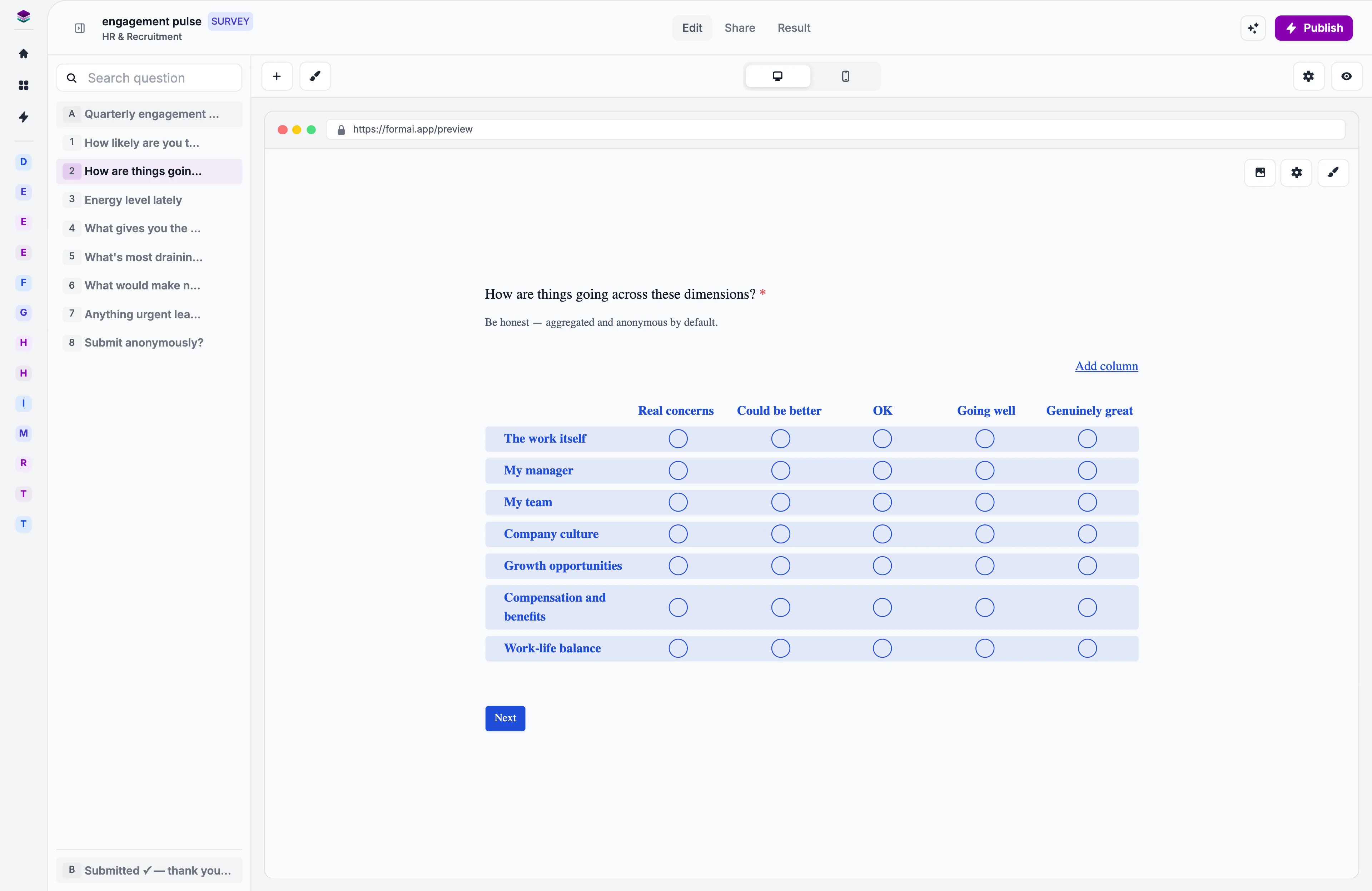
The May 4, 2026 public beta ships AI form generation and AI question refinement (bias/tone) for surveys. The richer engagement workflow is on the roadmap.
- AI-generated pulse surveys (shipping at beta): Describe your goal ("monthly engagement pulse for remote engineering team") and FormAI generates a complete, bias-checked survey in seconds
- Smart scheduling and rotation (coming soon): Set cadence, define question banks, and the platform handles rotation so employees never see the same survey twice
- Real-time analytics dashboards (shipping at beta): Live response dashboards, response KPIs, per-question breakdowns, word clouds, leaderboards, and AI report generation surface insights as responses arrive
- AI sentiment and theme analysis (coming soon): Sentiment analysis, theme clustering, anomaly detection, and cross-segment comparison run automatically as responses arrive, no manual analysis
- Predictive alerts (coming soon): At-risk teams and individuals are flagged based on pattern recognition across multiple pulse cycles
- Manager dashboards (coming soon): Each manager sees their team's results alongside AI-recommended actions, not raw data
- Integration with corporate training workflows (coming soon): Pair engagement pulses with corporate training effectiveness quizzes and gamification in training sessions for a complete employee development picture
The goal is for the platform to handle the infrastructure so people teams can focus on what matters: interpreting insights and driving change.
What to do Monday morning
You do not need a 6-month implementation plan. You need momentum. Here are three concrete steps to execute this week.
Step 1: Launch your first pulse survey by Wednesday
Pick Template 5 (eNPS Quick Pulse). It is 3 questions, takes 90 seconds to complete, and gives you a baseline engagement metric immediately. Use FormAI to generate the survey, set it to anonymous, and send it to a single department as a pilot. Do not over-engineer. Launch and learn.
Step 2: Share results with managers by Friday
Within 48 hours of closing the pilot, share the AI-generated summary with the participating department's manager. Include the top theme from open-text responses and one recommended action. This demonstrates the speed advantage over the annual survey, from launch to insights in less than a week.
Step 3: Schedule the second pulse for next week
Consistency builds trust. By running a second pulse the following week, even with the same pilot group, you signal that this is a continuous program, not a one-off experiment. Add one question from Template 2 (Manager Effectiveness) to begin building a richer picture.
The companies that win the talent war will not be the ones with the best perks. They will be the ones that listen fastest and act first. Start your first AI-powered pulse survey with FormAI or explore how gamification in corporate training complements your engagement strategy.